'/%3E%3C/svg%3E)


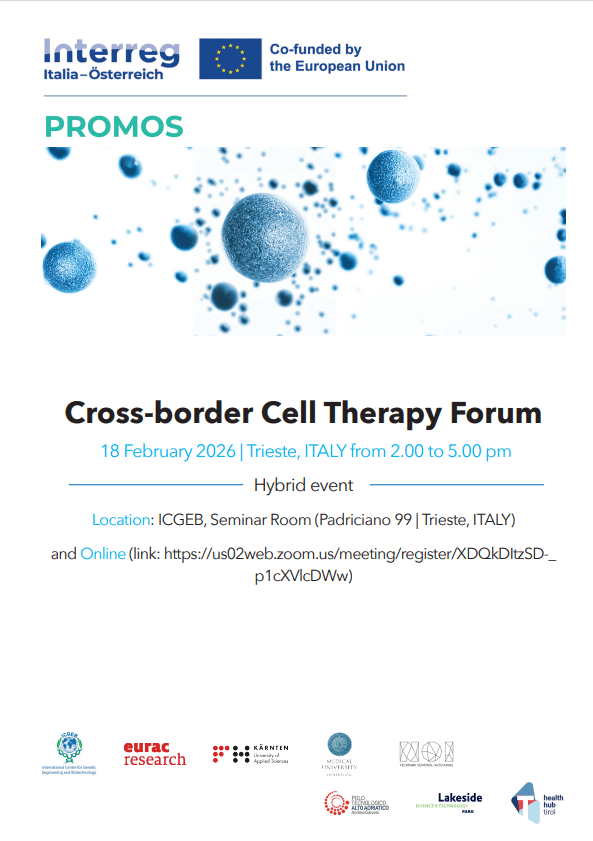
CROSS-BORDER CELL THERAPY FORUM
18/02/2026 - ICGEB, Trieste, Italy
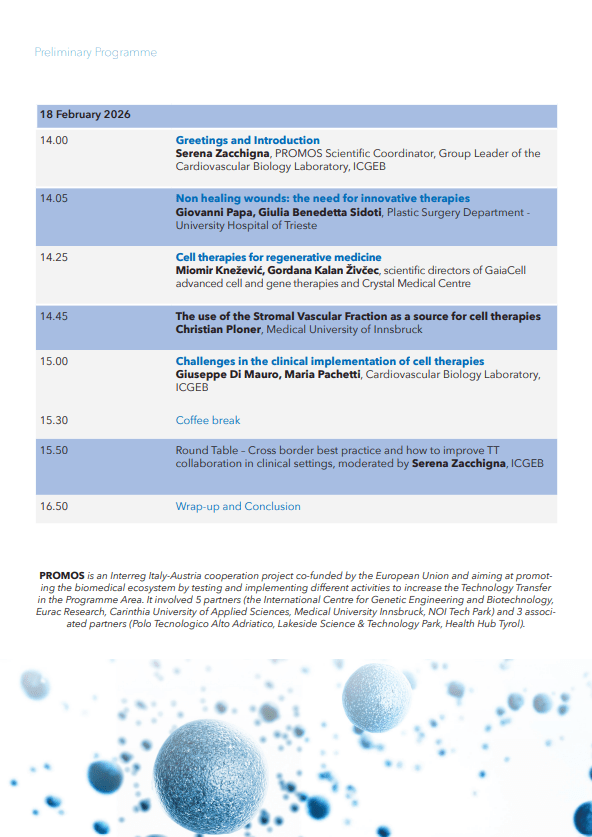
The Cross-Border Cell Therapy Forum brought together clinicians, researchers, technology transfer experts, and regulatory stakeholders from Italy, Austria, and Slovenia to discuss the current state and future of cell therapies in regenerative medicine. The event was organized within the framework of the PROMOS Interreg Italy–Austria project, aimed at strengthening the biomedical ecosystem and accelerating technology transfer in the programme area, with a specific focus on moving innovative cell-based therapies closer to clinical application in its WP3.
The forum also benefitted from the participation of the Interreg project COHERENCE, which intends to advance the development of an effective treatment for difficult wounds and to develop an open platform that guides researchers in regulatory compliance, in the cross-border area of Italy and Slovenia.
The event combined scientific presentations with a roundtable discussion focused on regulatory, financial, and implementation challenges affecting the uptake of cell therapies in clinical settings.
Key Themes and Scientific Contributions
The scientific sessions highlighted both clinical needs and therapeutic innovations:
- Non-healing wounds were presented as a significant unmet medical need, with chronic and complex wounds requiring new regenerative solutions beyond conventional treatments.
- Advances in cell therapies for regenerative medicine, including the use of stromal vascular fraction (SVF) derived from adipose tissue, were discussed as promising approaches for tissue repair and restoration.
- Speakers emphasized the need of a paradigm shift in both clinical protocols and evaluation frameworks for cell therapy approaches aiming at regenerating non healing wounds.
A recurring message across presentations was that cell therapies are highly individualized and do not fit easily within traditional therapeutic or clinical trial models. Each case often requires a personalized approach, challenging standardized inclusion criteria and classical efficacy measurements.
Regulatory and Implementation Challenges
The roundtable discussion brought forward critical systemic barriers to clinical implementation:
Regulatory Complexity and Fragmentation
Participants stressed the need for a more harmonized European regulatory framework. Current regulation remains heavily Member State–oriented, leading to inconsistencies and uncertainty in implementation pathways.
The discussion highlighted:
- Ambiguities surrounding hospital exemption procedures versus full clinical trial requirements.
- The significant administrative burden involved in preparing clinical trial dossiers.
- Lack of clarity regarding decision-making authorities and reimbursement approval processes.
The COHERENCE experience illustrated regulatory instability: initial rejection of hospital exemption as a pathway, followed by later reconsideration, while considerable time and resources had already been invested in clinical trial preparation.
Evidence and Evaluation Models
Cell therapies challenge traditional evidence-based medicine frameworks:
- Standard clinical trial designs are difficult to apply due to heterogeneous patient populations and personalized treatment approaches.
- Measuring efficacy using conventional endpoints may not capture therapeutic impact.
- Nevertheless, safety, efficacy, and quality remain essential criteria, as emphasized during the discussion.
Participants agreed that innovative therapies must still comply with rigorous safety and quality standards, but protocols and evaluation methodologies must evolve alongside medical innovation.
Reimbursement and Financial Barriers
A major concern is that patients often bear the cost of treatment due to limited reimbursement pathways. Key open questions include: How can individual successful cases be translated into recognized evidence? What mechanisms allow national health systems to reimburse advanced therapies? Who determines funding eligibility, and based on which criteria?
Although some cell therapies receive reimbursement, the procedures remain complex and insufficiently transparent.
Cross-Border Collaboration and Technology Transfer
The forum underscored the added value of cross-border cooperation within the Italy–Austria–Slovenia area and proposed the creation of a network to support each others. Shared challenges in regulation, clinical translation, and technology transfer make coordinated action particularly relevant. In this respect, PROMOS activities aims to
- Strengthen collaboration between research institutions, hospitals, and innovation ecosystems.
- Promote best practices in technology transfer.
- Facilitate dialogue between clinicians, scientists, and regulators.
The roundtable emphasized that stronger communication between stakeholders, publication of clinical results, and improved dissemination of evidence are essential to move the field forward. PROMOS reports and papers are also available here.
Conclusions
The Cross-Border Cell Therapy Forum confirmed both the transformative potential of regenerative medicine and the systemic obstacles that hinder its clinical uptake.
Some take-away messages:
- Cell therapies represent a rapidly evolving field requiring adaptive regulatory and clinical frameworks.
- Harmonization at European level would facilitate cross-border implementation and reduce uncertainty.
- Evidence generation remains central, even in personalized medicine contexts.
- Clearer reimbursement pathways are urgently needed to ensure equitable patient access.
- Cross-border initiatives such as PROMOS and COHERENCE play a strategic role in fostering dialogue, aligning practices, and accelerating translation from laboratory to clinic.
The event successfully created an opportunity for interdisciplinary exchange and highlighted concrete policy and operational questions that require further coordinated action at regional and European levels.
If you want to get into contact with us, please contact: Serena.zacchigna@icgeb.org